
Othello live outside Lichfield Cathedral, a Young Critic Review
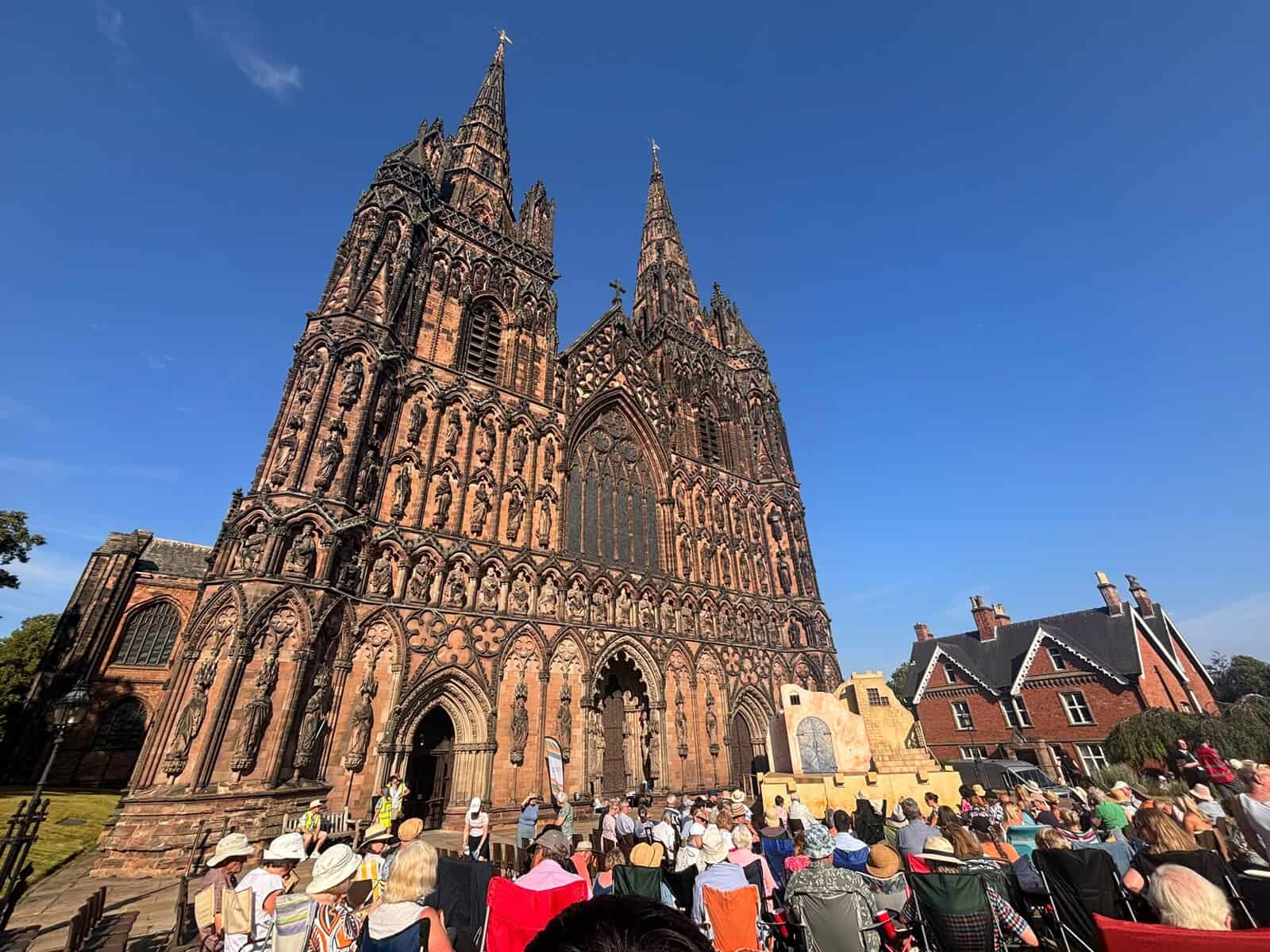
The Festival has kicked off with the high drama of Othello staged outside Lichfield Cathedral by The Lord Chamberlain’s Men. Young Critic Lucian tells us how ‘it almost felt that you were a guilty bystander to Iago’s callous plot.’
Lichfield Festival has just hosted one of Shakespeare’s greatest: “Othello”. The setting could not have offered anymore justice to the esteemed classic, with the cathedral artistically looming over the decorative stage. Before the play commenced the crowd absorbed the welcome evening rays, that only the greatest evenings preserve.
As the seven actors of the Lord Chamberlain’s men entered the stage the mood was assured by atmospheric voices. To say you were immersed in another timeline would be an understatement, as it almost felt that you were a guilty bystander to Iago’s callous plot. As the opening scenes progressed, the audience were exposed to bright costumes, authentic Shakespearian language, and raw talent of the men who displayed a historic reflection of how such plays would have been executed.
As was expected by one of literatures most resented villains, Iago held a brooding presence. The power he had over the audience was evident as it was always difficult to ignore his presence in scenes he rarely contributed dialogue to. The actor presented his character with an abundance of emotion, in particular his soliloquys which held an excruciating tension that was successfully intolerable.
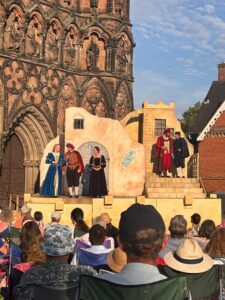 The play is one of a prolonged deterioration in the order of events. A particular moment that reflected this was the humorous scene when Cassio was subject to heavy drinking, encouraged by Iago. This marked the chaos that was to unfold, while providing comic relief.
Furthermore, the tragic protagonist Othello was portrayed as a psychotic mirror image of Iago his phycological master. The quote “Blood, blood, blood” was a standout to mark his loss of control. Furthermore, his outfit emitted the presence of his military hat towards the end. This dramatic decision contributed to the abandonment of his formerly responsible post as military commander.
Traditionally men would play the role of women. This was adopted by the traditionally bound group of actors. The female roles were given freedom to grow in character, ultimately being called “simple” and other derogatory terms before their death, in which they were most valiant. For a powerless audience the play was a frustrating masterclass, raising the questions of what could have been without the naive blindness of certain characters.
To conclude a beautiful, scenic evening the actors cyclically performed a final song. The white bed gown of Desdemona was now transformed into a metaphorical funeral shroud as the crowd rejoiced in avid appreciation for the prefect evening the talented actors had supplied.
By Lucian C
Lucian is an A-level student studying English, history and philosophy. He has a great passion for writing and love for literature. He also plays football and loves music.
If you’re aged 11-18 and would like to be a festival reviewer, applications will open soon for Young Critics – find out more on our website https://lichfieldfestival.org/aspire/young-critics/