
However big your family reunions are, this is bigger – Tracey Boreman ‘The Stolen Crown’

Young Critic, Isla, had the chance to interview historian, author, and presenter Tracey Boreman on her new book ‘The Stolen Crown’. From power struggles to wedding venues, Boreman covers it all.
Can the Chief Historian at the Historic Royal Palaces pick just one favourite Royal Palace? Though Borman got married at the Tower of London (what a venue!) one other takes the cake for her. Read on to find out…
I was at the Guildhall to see Tracy Borman talk about her new book, ‘The Stolen Crown, Treachery, Deceit and the Death of the Tudor Dynasty’. Having enjoyed her books and documentaries in the past (and most recently citing her argument in The Stolen Crown in my history coursework), I was very excited to see her talk, and was clearly not the only one, as the room was packed for her second event of the day. An aside, but public historians working in heritage and TV do incredibly important work to bring history and scholarship to a wider audience.
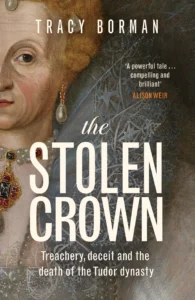
In ‘The Stolen Crown’, Borman uncovers new research about the dying days of Elizabeth I, bringing to life how the end of a century old dynasty brought uncertainty and conspiracy to the Tudor Court, and reconsidering the smooth transition Stuart propogandists wanted to enshrine in history. Charting a complicated web of Tudor relatives (however big your family reunions are, this is bigger) and Stuart cover-ups, Borman explains how Elizabeth died without naming an heir. Furthermore, Borman explains how James ignored her carefully considered advice in ruling the country she had governed for decades, to… do his own thing. Could this have had anything to do with the Civil War which broke out not long after, I wonder?
Borman’s wonderfully chatty style brought the family trees and historic manuscripts to life, making her talk feel relaxed and warm. The audience was clearly engaged, laughing at Borman’s quips and asking relevant questions, and this was made possible by her method of delivering history approachably, assuming no prior knowledge and using a set of slides to illustrate her points. If I had to make one suggestion, it’s that I would have liked to hear more about the actual power-exchange and the long-term effects of such power-plays, as much of the talk was focused on the build-up.
As someone who has been reading about the Tudors for a long time, it is always fascinating to hear a fresh perspective on an ever-popular era of British history. Delivered with great style and enthusiasm, Borman did a fantastic job, and her book is on sale now.
 Meeting her after the talk, she was just as friendly in person as she seemed on stage, and before I reveal her favourite historic palace, I couldn’t pass up the opportunity to ask a ‘nerdy’ question about what I am studying in school. The early Stuarts are famous for their belief in the Divine Right of Kings, which contributed to conflict with Parliament over its role in the state. Borman agreed that the disruption from moving between the Elizabethan and the foreign Stuart dynasty was a key contributor to the sense that the world was “Turned Upside Down” in the years leading up to the Civil War. This perhaps explains why the Stuart court wanted to establish a seamless transition between James and Elizabeth so badly. A powerful reminder that history is written and rewritten according to who it serves…
And of course, Borman’s favourite royal palace is Hampton Court, and who could disagree? Ghosts, queens, and plots haunt these walls, which act as a rich backdrop for so many of the stories Borman writes about and in time, I’m sure, will tell many more.
By Isla B
Isla is in Y13 preparing to go to university to study History next year, in time she would love to write as part of her career, or maybe work in museums. She reads lots of historians but a favourite author is Margaret Atwood. Young Critics was a fantastic credit applying to university and has given her lots of opportunities to hear from some great authors.
If you’re aged 11-18 and would like to be a festival reviewer, applications for Young Critics are open for Lichfield Festival – find out more on our website https://lichfieldfestival.org/aspire/young-critics/